If you’ve ever rung around for a quote and asked “so, does the cleaner do the ironing too?” you’re not being difficult. You’re just standing in the middle of a mix-up that’s been brewing for a few hundred years and somehow still hasn’t been sorted out, not even by the people whose entire job is sorting things into neat categories.
At Reflection Cleaning QLD (RCQ), we get asked the cleaner-vs-maid question all the time. So let’s actually dig into where it comes from, because it’s a better yarn than you’d expect, and it turns out Australia handles this whole thing a bit differently to everyone else.
Turns out, Australia actually sorted this one out
Here’s a fun one. The Australian and New Zealand Standard Classification of Occupations (ANZSCO), the official system the Australian Bureau of Statistics uses to categorise every job in the country, actually splits this into two separate, clearly defined roles.
There’s Domestic Cleaner (ANZSCO 811311), which covers vacuuming, mopping, dusting, and cleaning bathrooms and kitchens. Full stop. That’s the job.
Then there’s Domestic Housekeeper (ANZSCO 811412), a completely different occupation that covers cleaning, cooking, doing the dishes, doing the laundry, ironing, grocery shopping, and even looking after pets and answering the phone.
Two separate job codes, two separate scopes of work. Compare that to the United States, where the Bureau of Labor Statistics lumps “maids” and “housekeeping cleaners” into a single combined job code and calls it a day. So if anything, we’re ahead of the Americans on this one. Bit of a rare W for Australian bureaucracy.
So where does “maid” even fit in?
Here’s the twist. Go looking for “maid” in ANZSCO and you’ll come up empty. It’s not an official job title in Australia at all. There’s no ANZSCO code for it, no unit group, nothing. Officially, in this country, you’ve got cleaners and you’ve got housekeepers. “Maid” is a term we’ve mostly borrowed from British and American pop culture, hotel branding, and the general vibe of period dramas where someone’s always dusting a mantelpiece in a pinafore.
That matters for the confusion, because when people use the word “maid” in Australia, they’re not pulling from a defined local job description. They’re pulling from decades of movies, hotel signage, and half-remembered vibes, which is exactly the kind of thing that leads to someone assuming their booked “maid service” will also handle three loads of washing.
Where “maid” actually comes from is even weirder
According to Etymonline, a well-regarded etymology reference, the word “maid” originally had nothing to do with cleaning whatsoever. Around the year 1200, it simply meant an unmarried young woman, essentially “maiden” for short. It wasn’t until roughly the year 1500 that it picked up the humbler meaning of a female servant handling domestic duties.
The specific phrase “maid of all work,” meaning a servant who handled literally everything in a household (laundry, cooking, cleaning, all of it) only shows up in the record from 1790 onward. So for well over two centuries, “maid” has genuinely meant “does the lot.” No wonder the assumption sticks around.
“Cleaner,” on the other hand, has always been dead simple. Dictionary.com traces it back to Middle English clener, first recorded between 1425 and 1475, built straight from “clean” plus the agent suffix “-er.” Someone who cleans. No detours through virtue, marriage status, or 500 years of scope creep.
What this actually means when you’re booking someone
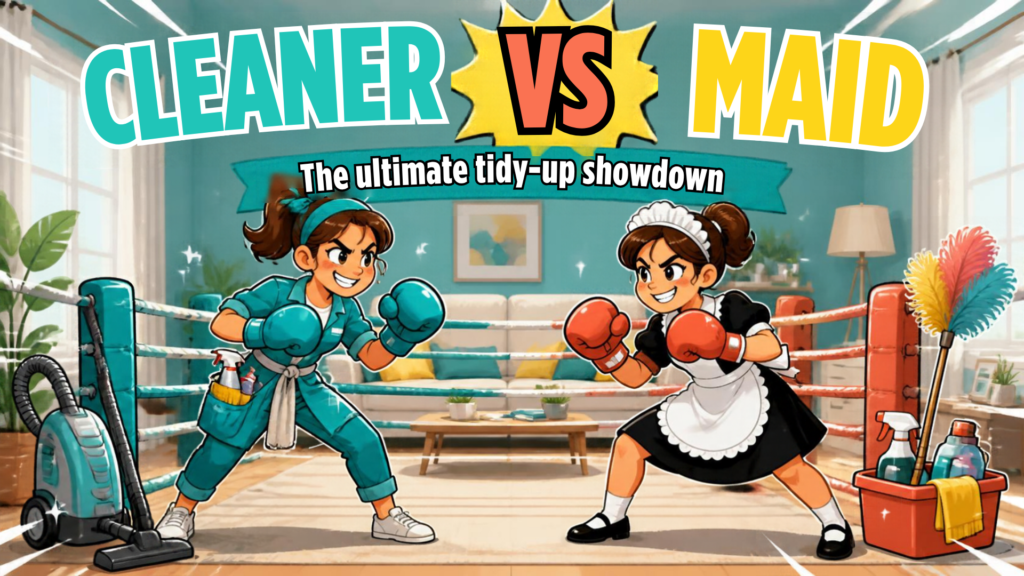
Since “maid” isn’t a defined role here, the two terms that actually matter in Australia are cleaner and housekeeper, and ANZSCO’s split lines up pretty closely with how most local cleaning businesses (RCQ included) structure their services.
A cleaner typically covers:
- Vacuuming, mopping, dusting
- Bathrooms and kitchens
- Windows and glass surfaces
- General tidying
A cleaner typically doesn’t cover:
- Laundry and ironing
- Grocery shopping or errands
- Cooking or dishes from last night
- Pet care or general household admin
Those broader tasks sit under housekeeping, and the scope still varies company to company, so it’s always worth asking upfront rather than assuming.
One more bit of local flavour worth knowing. Queensland accounts for one of the largest shares of the country’s Domestic Housekeepers, according to Jobs and Skills Australia data drawn from the ABS Census, right up there with New South Wales. So this isn’t some niche question. It’s one a lot of Queenslanders are quietly wondering about too.
Sorted (mostly)
The cleaner-vs-maid confusion isn’t a you problem, and it’s not really an us problem either. It’s a few hundred years of borrowed language colliding with a job title that was never official here in the first place. Even the ABS had to draw a formal line to make sense of it.
The bit that actually matters for you: ask what’s included before you book, rather than relying on a job title to tell the whole story. At RCQ, we’re upfront about scope from the first phone call, so there’s no confusion about whose job it is to deal with that mountain of washing on the end of the bed.
Sources
Australian Bureau of Statistics. “8113 Domestic Cleaners,” ANZSCO. abs.gov.au
Australian Bureau of Statistics. “8114 Housekeepers” / Domestic Housekeeper 811412, ANZSCO. abs.gov.au
Jobs and Skills Australia. “Domestic Housekeepers, Occupation Profile” (state share data).
jobsandskills.gov.au
U.S. Bureau of Labor Statistics. “Maids and Housekeeping Cleaners,” SOC 37-2012. bls.gov
Harper, D. “Maid (n.).” Etymonline. etymonline.com/word/maid
Dictionary.com. “Cleaner.” Word History and Origins. dictionary.com/browse/cleaner